
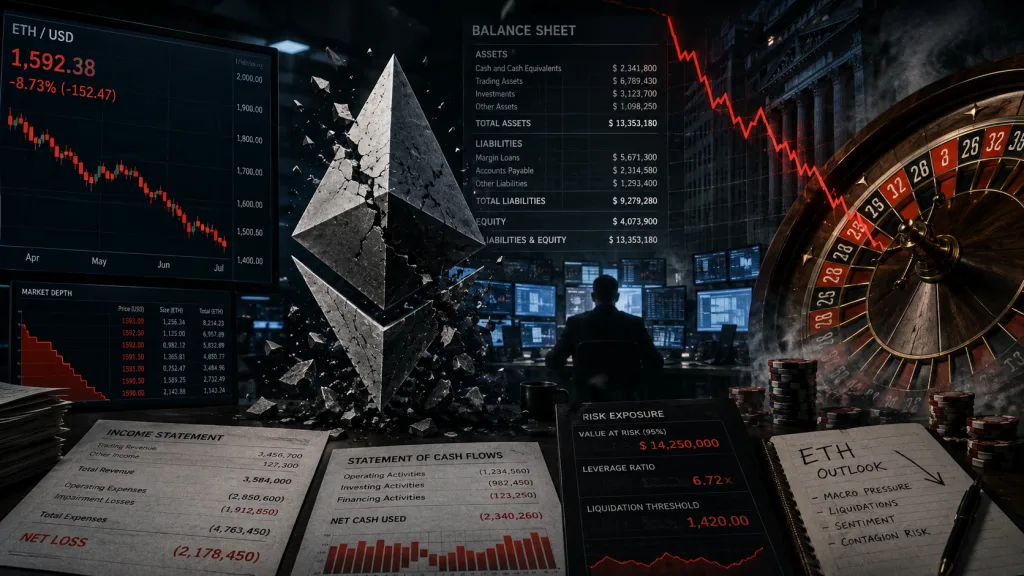
There is a thin line between conviction and casino behavior. In crypto treasury stocks, that line is often hidden under phrases like “institutional adoption,” “tokenization,” “AI demand,” and “long-term accumulation.”
Tom Lee’s BitMine is now one of the clearest examples of that line.
On paper, the story is simple: BitMine is trying to become the Ethereum version of Strategy, formerly MicroStrategy. Instead of using a public company balance sheet to accumulate Bitcoin, BitMine is using a public company balance sheet to accumulate ETH.
But the more interesting question is not whether Tom Lee is bullish on Ethereum. Everyone already knows that. The real question is this:
Who is funding this trade, who benefits from keeping the ETH narrative alive, and what happens if ETH keeps falling?
This Is Not a Secret Lobby. It Is a Very Public Capital Markets Machine.
The lazy explanation would be to say that Tom Lee is a puppet of some hidden Ethereum lobby. That is emotionally satisfying, but it is not the cleanest explanation.
The cleaner explanation is this: BitMine is a publicly traded ETH treasury vehicle backed by a visible group of institutional crypto investors and financed through capital markets.
BitMine itself says it remains supported by institutional investors including ARK’s Cathie Wood, MOZAYYX, Founders Fund, Bill Miller III, Pantera, Kraken, DCG, Galaxy Digital, and Tom Lee personally. The company’s stated goal is to acquire 5% of the ETH supply. As of June 21, 2026, BitMine reported holdings of 5,672,956 ETH, equal to about 4.7% of total ETH supply, plus cash, marketable securities, Bitcoin, and other investments.
So no, this does not require a secret conspiracy. It is much more straightforward.
It is a large, coordinated, institutional ETH trade wrapped inside a public equity structure.
The Narrative: Ethereum as Wall Street Infrastructure
BitMine’s public story is not just “ETH will go up.”
The company frames Ethereum as a core infrastructure layer for future finance: tokenization, stablecoins, public blockchains, staking, and even AI-related demand. Tom Lee has repeatedly pushed the idea that crypto is entering a new phase and that Ethereum is still early in its institutional adoption cycle. BitMine’s own press release says tokenization and AI are expected to drive exponential demand for blockchain and decentralized crypto.
That narrative matters because the trade only works if investors keep believing that ETH is not just another crypto asset, but a strategic reserve asset for the next financial system.
That is the sales pitch.
The risk is that ETH has spent years frustrating investors. It has underperformed Bitcoin for long stretches, faced competition from faster chains, suffered from confusing monetary narratives, and often looked like a technically important asset with poor price action.
That is why the BitMine trade is so intriguing: it is not merely a bet on ETH. It is a bet that public markets will eventually reward ETH accumulation the way they rewarded Strategy’s Bitcoin accumulation in the previous cycle.
Why Falling ETH Can Look “Good” — Until It Stops Being Good
A falling ETH price does not fundamentally help BitMine. If a company owns millions of ETH, a lower ETH price means the value of its treasury falls.
At the current ETH price of about $1,687, BitMine’s reported 5.67 million ETH would be worth roughly $9.57 billion, compared with about $9.83 billion at the $1,733 ETH price used in its June 21 update.
However, falling ETH can be useful tactically if BitMine can still raise capital. If the company can sell common stock, preferred stock, or other instruments, then lower ETH prices allow it to buy more ETH per dollar raised.
That is the treasury-company loop:
- Sell securities.
- Raise cash.
- Buy crypto.
- Promote crypto-per-share growth.
- Maintain investor confidence.
- Repeat.
The problem is obvious: this only works while the market keeps funding the trade.
Once confidence breaks, lower ETH prices are no longer “cheap accumulation.” They become a balance sheet problem.
Is BitMine Underwater?
Based on the latest available public data, yes, BitMine is almost certainly deeply underwater on its ETH position.
The exact current average cost is not fully disclosed in the latest weekly holding update, so any current break-even estimate must be treated as an estimate. But the February 28, 2026 10-Q gives a clear starting point: BitMine held 4,473,459 ETH with a cost basis of about $16.973 billion and fair value of about $8.793 billion. That implies an average cost of roughly $3,794 per ETH on that reported position.
Since then, BitMine added more ETH at lower prices. That likely reduced the blended average cost. A reasonable estimate, depending on the average price of later purchases, puts BitMine’s current ETH break-even roughly around:
$3,350–$3,500 per ETH
With ETH around $1,687, that implies BitMine’s ETH position may be about 50% below its blended cost basis, with an estimated paper loss in the area of $9.5–$10.4 billion on the ETH stack alone. This is an estimate, not an official company number, because the latest full cost basis for all 5.67 million ETH has not yet been disclosed.
That is not a small mark-to-market problem. That is the entire trade under stress.
Strategy/MSTR: The Original Bitcoin Treasury Machine
Strategy is the obvious comparison. Michael Saylor’s company created the public-company crypto treasury template: issue capital, buy Bitcoin, promote Bitcoin per share, and turn the stock into a leveraged Bitcoin proxy.
As of June 22, 2026, Strategy reported 847,363 BTC with an average purchase price of $75,651 per BTC.
With Bitcoin around $62,879, Strategy is also underwater on its Bitcoin stack.
The rough math:
| Company | Asset | Holdings | Estimated / Reported Break-even | Current Price | Approx. Status |
|---|---|---|---|---|---|
| BitMine | ETH | 5.67M ETH | ~$3,350–$3,500 | ~$1,687 | Deeply underwater |
| Strategy | BTC | 847,363 BTC | $75,651 | ~$62,879 | Underwater by ~$10.8B |
Strategy’s current unrealized BTC loss is roughly:
$75,651 – $62,879 = $12,772 per BTC
$12,772 × 847,363 BTC = about $10.8 billion
That is serious, but Strategy has been through deep drawdowns before.
How Bad Was MSTR in the Previous Cycle?
In the 2022 bear market, Bitcoin reached a cycle low of about $15,760 on November 21, 2022.
At the end of Q3 2022, MicroStrategy reported a Bitcoin average cost of about $30,639 per BTC.
That means MSTR was roughly:
48.6% underwater on Bitcoin at the cycle low
In dollar terms, using roughly 130,000 BTC at the time, the paper loss was close to $1.9 billion.
The stock also collapsed. MicroStrategy later executed a 10-for-1 stock split in 2024, so historical prices should be viewed on a split-adjusted basis.
Around the late-2022 bottom, MSTR traded roughly in the mid-teens to low-20s split-adjusted. Monthly historical data show an average around $19.81 in November 2022 and $14.16 in December 2022, split-adjusted.
That is the important comparison: Strategy survived an approximately 50% underwater position before. But today’s capital structure is larger and more complex.
What Would MSTR Look Like in a New Bear Cycle?
This is where the analysis becomes more uncomfortable.
Strategy is no longer just a company holding Bitcoin. It now has a much larger capital stack above common shareholders. As of May 25, 2026, Strategy reported $6.7 billion of convertible notes, $15.5 billion of preferred stock notional, and a $871 million USD reserve.
This does not mean Strategy is immediately insolvent if Bitcoin falls. Preferred stock is not the same as conventional debt. But from a common-equity stress-test perspective, it matters.
Using Strategy’s reported 847,363 BTC and about 388.6 million diluted shares, Strategy has roughly:
0.00218 BTC per diluted share
That gives the following rough BTC-linked value per MSTR share before adjusting for debt, preferred stock, cash, software value, or market premium:
| BTC Price | Gross BTC Value per MSTR Share |
|---|---|
| $50,000 | ~$109 |
| $40,000 | ~$87 |
| $30,000 | ~$65 |
| $25,000 | ~$55 |
| $20,000 | ~$44 |
If we apply a harsher stress model and subtract convertible debt plus preferred notional, net of cash reserve, the common-equity residual becomes much lower:
| BTC Price | Stress-Model Residual per MSTR Share |
|---|---|
| $50,000 | ~$54 |
| $40,000 | ~$32 |
| $31,500 | ~$14 |
| $30,000 | ~$11 |
| $25,000 | Around zero |
| $20,000 | Negative |
This does not mean MSTR must trade exactly there. The stock can trade at a premium, at a discount, or as a long-dated call option on Bitcoin recovery. But it shows the key pressure point:
If Bitcoin falls toward $30,000–$32,000, MSTR common equity could plausibly trade in the $10–$35 range. If Bitcoin falls toward $25,000, common equity begins to look distressed under a harsh residual-value model.
That is not a prediction. It is a stress test.
Why BitMine May Be Riskier Than Strategy
The difference between Strategy and BitMine is not just BTC versus ETH.
Strategy has already survived a full crypto winter as a Bitcoin treasury company. It was badly underwater in 2022, but it survived the cycle, benefited from the 2023–2025 recovery, and turned itself into the dominant public Bitcoin treasury vehicle.
BitMine has not yet passed that test.
Its ETH treasury strategy is newer. It is being tested almost immediately by weak ETH price action. And ETH itself is a more complicated institutional story than Bitcoin. Bitcoin has a simple reserve-asset narrative. Ethereum has a more sophisticated but less clean story: smart contracts, tokenization, staking, stablecoins, L2s, validator economics, and application demand.
That complexity can be a strength.
It can also be a marketing problem.
Is This Investing or Gambling?
The uncomfortable answer is: both.
It is investing because these companies are using real capital markets instruments, public disclosures, treasury strategies, staking operations, and balance sheet structures.
It is gambling because the entire model depends on reflexivity.
If the asset price rises, the stock can trade at a premium, the company can issue more securities, buy more crypto, and reinforce the narrative.
If the asset price falls, the same loop works in reverse. The premium disappears, financing becomes expensive, dilution becomes painful, preferred dividends become a burden, and the treasury asset no longer looks like strategic accumulation. It looks like a giant bag.
That is why the phrase “a group of rich gamblers” is crude, but not entirely wrong.
A more precise description would be:
This is an institutional casino trade with a balance sheet, a ticker symbol, and a very sophisticated narrative.
The Bottom Line
Tom Lee is probably not a puppet of a secret Ethereum lobby. The truth is more obvious and more interesting.
BitMine is funded by public markets and supported by institutional crypto investors who benefit from keeping the Ethereum institutional adoption story alive. Those investors may genuinely believe in ETH. They may also benefit from volatility, capital raising, staking, custody, liquidity, and the public-market packaging of crypto exposure.
But the math is not forgiving.
BitMine likely needs ETH far above current levels to repair its treasury economics. Strategy needs Bitcoin back above its average cost to eliminate its current unrealized loss. Both companies can survive drawdowns if capital remains available and market confidence holds.
But if the next bear leg takes ETH and BTC significantly lower, these treasury vehicles stop looking like visionary accumulation machines.
They start looking like leveraged public-market wrappers around falling crypto collateral.
And that is the real risk: not that Tom Lee is wrong in theory, but that the capital structure may not be patient enough for the theory to become true.


