
Bitcoin, the first and most prominent cryptocurrency, has experienced significant price fluctuations since its inception. From its humble beginnings valued at mere cents to reaching all-time highs above $60,000, Bitcoin’s price history is marked by volatility and rapid shifts in market sentiment. Understanding these long-term trends is essential for investors aiming to navigate the dynamic crypto market effectively.
This analysis examines Bitcoin’s price action against USDC over an extended period, providing insights into historical trends, market volatility, and key technical indicators. By taking a broad view, we can better comprehend Bitcoin’s behavior during major bull and bear cycles, which is crucial for anticipating future price movements.
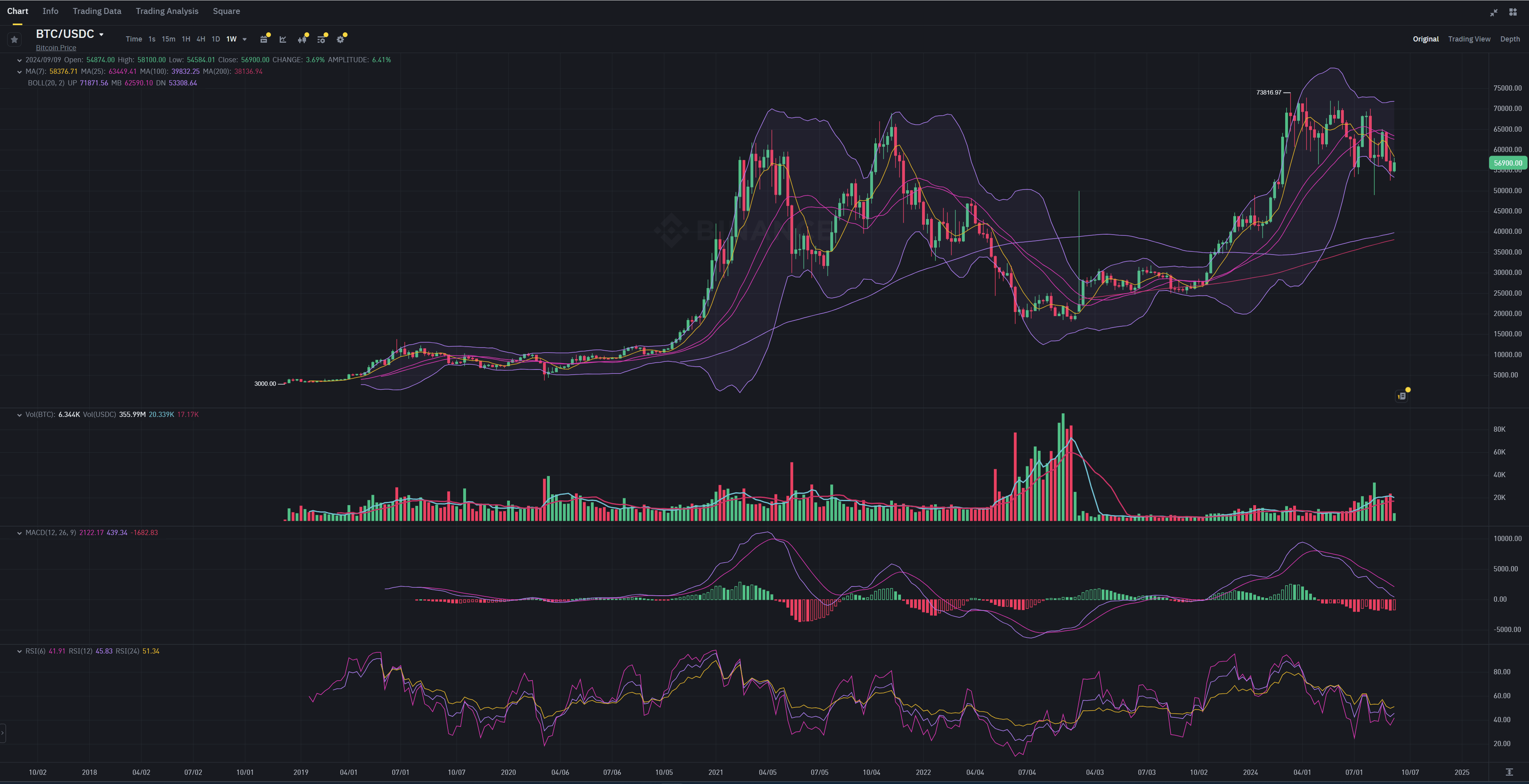
1. General Trend Overview
The chart illustrates Bitcoin’s historic rise from around $3,000 to over $60,000, marked by several phases of extreme volatility and corrections. The significant rally in 2021, which peaked above $60,000, was followed by a notable correction phase, pulling the price down to lower levels. Currently, Bitcoin appears to be in a consolidation phase following this correction, indicating market indecision and anticipation of the next major move.
2. Technical Indicators
Technical indicators are mathematical calculations based on a security’s price, volume, or other market data. In this case, we’re focusing on three main indicators: Bollinger Bands, MACD, and RSI.
a) Bollinger Bands:
Bollinger Bands consist of three lines: a middle moving average (typically the 20-period simple moving average) and an upper and lower band, which are standard deviations away from the moving average. These bands expand and contract based on the volatility of the market. Here’s what they tell us in this scenario:
- Current Width of the Bands: The chart shows that the bands are relatively wide, indicating higher volatility in the market. This is normal during periods of price corrections or major market movements.
- Price Position within the Bands: Bitcoin is trading within the Bollinger Bands, which suggests relative price stability at the moment. When prices are near the upper band, it usually indicates an overbought condition, while prices near the lower band suggest an oversold condition. Right now, the price seems to be neither at the extreme top nor bottom, suggesting the market is in a consolidation phase.
- Potential Breakout: If Bitcoin breaks out above the upper band with strong volume, this could indicate the start of a bullish trend. Conversely, if it drops below the lower band, a bearish trend could follow. Since the bands are currently wide, it indicates the market is still deciding on a direction, and volatility could increase further.
b) MACD (Moving Average Convergence Divergence):
MACD is a trend-following momentum indicator that shows the relationship between two moving averages (usually the 12-day and 26-day exponential moving averages). It consists of two lines: the MACD line and the signal line, along with a histogram that shows the difference between the two.
- MACD Line vs Signal Line: On the chart, the MACD line is currently below the signal line, which is a bearish signal. This crossover suggests that downward momentum is stronger, and the market may experience further price declines or at least a lack of bullish momentum.
- Histogram Analysis: The histogram, which visually represents the difference between the MACD line and the signal line, shows declining positive momentum. When the histogram is above zero, it suggests that the MACD is above the signal line, and vice versa. In this case, the histogram is in negative territory, further supporting a bearish outlook.
- Long-term Interpretation: This bearish crossover aligns with the overall correction phase in the market. It suggests that Bitcoin may continue to face downward pressure until we see a new bullish crossover, where the MACD line moves above the signal line again.
c) RSI (Relative Strength Index):
RSI is a momentum oscillator that measures the speed and change of price movements on a scale of 0 to 100. Typically, an RSI reading above 70 indicates that the asset is overbought (possibly a sign of a future price correction), while an RSI reading below 30 indicates that the asset is oversold (potentially signaling a price rebound).
- Current RSI Value: The current RSI is near 50, which suggests a neutral market condition. It means the price is neither overbought nor oversold. This is in line with the market’s consolidation phase after the strong price corrections seen earlier in 2021.
- Implication of Neutral RSI: A neutral RSI could mean that traders are indecisive and waiting for a catalyst to move the market. As a momentum oscillator, RSI gives insight into potential price reversals. However, in this case, there is no clear indication of immediate oversold or overbought conditions, which reinforces the idea that the market may continue in consolidation mode.
- Trend Watch: If RSI begins to approach either the 70 or 30 levels, it could signal a more definitive trend (either bullish if it moves up or bearish if it moves down). Therefore, it’s important to monitor RSI for any significant deviations from the neutral zone.
3. Analysis of Trading Volume
Trading volume is one of the most crucial metrics in technical analysis because it measures the strength behind price movements. It can help confirm the validity of a price movement and indicate whether a trend is likely to continue or reverse.
a) Volume Patterns and Trends:
- The trading volume on the chart appears to be considerably lower than the peaks seen during Bitcoin’s massive rallies. High trading volumes typically indicate strong investor interest, while low volumes may suggest a lack of conviction in the current trend.
- During the 2021 rally, we see a spike in volume, which confirmed the strength of the bullish trend and pushed the price to all-time highs. However, after Bitcoin hit its peak and entered the correction phase, trading volumes have generally diminished.
- Low Volume in Consolidation: Low trading volume during the current consolidation phase suggests that investors are waiting for clearer market direction before entering positions. This lack of strong buyer or seller conviction could lead to continued sideways movement until a breakout (either up or down) occurs.
b) Importance of Volume in Trend Confirmation:
- Bullish Breakout: For Bitcoin to resume a bullish trend, it’s essential that any price increase is accompanied by a rise in trading volume. A breakout without volume confirmation could be a false signal, potentially leading to a short-lived rally. If trading volume spikes while Bitcoin rises above resistance levels (such as the $60,000 mark), this would suggest strong market support and the possibility of a sustained upward move.
- Bearish Breakdown: Similarly, if Bitcoin drops below significant support levels (e.g., $30,000) with increasing volume, it could signal a continuation of the bearish trend, potentially leading to further downside. Low volume on a price drop might suggest that selling pressure isn’t strong enough to push the price much lower.
c) Volume as a Leading Indicator:
- Volume can often act as a leading indicator for price movement. If you notice a sudden increase in volume, even before a breakout or breakdown, this can signal that a significant price move is coming. Investors should watch closely for any unusual spikes in volume, as these could indicate that market sentiment is changing.
- Volume Divergence: Another important concept is volume divergence. If prices are rising but volume is falling, it can signal that the upward trend is weakening, possibly foreshadowing a reversal. Similarly, if prices are falling but volume is decreasing, it could suggest that the bearish trend is running out of steam.
4. Historical Resistance and Support Levels:
- There is a critical support level around $30,000, which is a key zone to watch in the event of further price corrections. If the price breaks below this support, it could trigger additional selling pressure, leading to a more significant drop.
- The upper resistance level is noted around $60,000, a break above which would likely signal a resumption of the bullish trend. For now, this resistance seems formidable, and the price has struggled to breach this level.
5. Conclusions and Future Trend Assumptions:
- Neutral to Bearish Trend: Based on current technical indicators (MACD, RSI), the market is showing signs of weakening bullish momentum, suggesting that Bitcoin could continue consolidating or experience minor declines.
- Key Support Level: A break below $30,000 would be a concerning signal for the bulls, potentially leading to further downward movement.
- Potential Bullish Trigger: On the other hand, if Bitcoin manages to break above the $60,000 resistance level with increased volume, this could signal the beginning of a new bullish trend, potentially driving the price to new highs.
For now, observers might focus on clearer signals (either a break of the support or resistance level) before making conclusions regarding future market direction. The long-term view offers valuable insights, but near-term caution is warranted until stronger momentum, either bullish or bearish, emerges from the current consolidation phase.


